Artículo original
Vol. 37 | Núm. 2
17 min
Clinical presentation, endoscopic findings and outcomes of community versus hospital-onset gastrointestinal bleeding in critically ill patients: factors associated with in-hospital mortality
Presentación clínica, hallazgos endoscópicos y desenlaces de la hemorragia digestiva de inicio comunitario versus intrahospitalario en pacientes críticos: factores asociados a mortalidad intrahospitalaria
Kevin Vásquez Dávila1*, Anapaula Aparicio2, Kevin Molina3, Edras Musus4
1 Department of Internal Medicine, Hospital Modular Zona Once, Guatemala City, Guatemala
2 Department of Internal Medicine, Hospital General de Enfermedades, Guatemala City, Guatemala
3 Department of Gastroenterology, Hospital Modular Zona Once, Guatemala City, Guatemala
4 Department of Gastroenterology, Hospital General de Enfermedades, Guatemala City, Guatemala
*Correspondencia:
Kevin Vásquez Dávila Instituto Guatemalteco de Seguridad Social
Recepción:
10/03/2026
Aceptación:
05/04/2026
Publicación:
17/06/2026
Métricas
207
Visualizaciones
19
Descargas
Compartir
Compartir
Resumen (ES)
Background: Gastrointestinal bleeding is a frequent and potentially life-threatening condition in critically ill patients. Outcomes may differ according to whether bleeding occurs in the community or during hospitalization, but comparative data in intensive care settings are limited. Objective: To compare in-hospital mortality between community-onset and in-hospital onset gastrointestinal bleeding in critically ill patients and to evaluate whether serum albumin levels and bleeding origin are independently associated with mortality. Methods: We conducted a retrospective observational study including adult patients admitted to intensive or intermediate care units with upper gastrointestinal bleeding. Clinical characteristics, endoscopic findings, organ support requirements, and in-hospital mortality were analyzed. Multivariable logistic regression was used to identify independent predictors of mortality. Results: Seventy-two patients were included; 56 had community-onset bleeding and 16 in-hospital onset bleeding. In-hospital mortality was higher in patients with in-hospital onset bleeding (43.8%) compared with community-onset bleeding (10.7%). Lower serum albumin levels were independently associated with increased mortality, while community-onset bleeding was associated with lower odds of death. Conclusions: In critically ill patients, in-hospital onset gastrointestinal bleeding is associated with worse outcomes and higher mortality. Serum albumin at admission may serve as a simple prognostic marker.
Palabras clave (ES):
Gastrointestinal bleeding
Community-onset
Intensive care unit
In-hospital onset
Mortality
Resumen (EN)
Antecedentes: La hemorragia digestiva es una condición frecuente y potencialmente mortal en pacientes críticamente enfermos. Los desenlaces pueden variar según si el sangrado ocurre en la comunidad o durante la hospitalización, pero los datos comparativos en unidades críticas son limitados. Objetivo: Comparar la mortalidad intrahospitalaria entre la hemorragia digestiva de inicio comunitario y la de inicio intrahospitalario en pacientes críticos, y evaluar si los niveles de albúmina sérica y el origen del sangrado se asocian de manera independiente con mortalidad. Métodos: Estudio observacional retrospectivo que incluyó pacientes adultos ingresados a unidades de cuidados intensivos o intermedios con hemorragia digestiva alta. Se analizaron características clínicas, hallazgos endoscópicos, requerimientos de soporte orgánico y mortalidad intrahospitalaria. Se utilizó regresión logística multivariable para identificar predictores independientes. Resultados: Se incluyeron 72 pacientes; 56 presentaron sangrado de inicio comunitario y 16 de inicio intrahospitalario. La mortalidad fue mayor en el grupo intrahospitalario (43,8%) comparado con el comunitario (10,7%). Niveles más bajos de albúmina se asociaron de forma independiente con mayor mortalidad, mientras que el inicio comunitario se asoció con menor probabilidad de muerte. Conclusiones: En pacientes críticos, la hemorragia digestiva de inicio intrahospitalario se asocia con peor pronóstico. La albúmina sérica al ingreso puede ser un marcador pronóstico útil.
Palabras clave (EN):
Hemorragia digestiva
Inicio comunitario
Unidad de cuidados intensivos
Inicio intrahospitalario
Mortalidad
Clinical presentation, endoscopic findings and outcomes of community versus hospital-onset gastrointestinal bleeding in critically ill patients: factors associated with in-hospital mortalityIntroduction
Gastrointestinal bleeding remains a frequent cause of hospitalization and admission to critical care units and continues to be associated with substantial morbidity and mortality [1,2]. Despite advances in diagnostic and therapeutic endoscopy, mortality in upper gastrointestinal bleeding remains approximately 5–10%, particularly among patients with significant comorbidities and physiological instability. Current international guidelines emphasize early risk stratification, prompt hemodynamic resuscitation, and timely endoscopic evaluation as the cornerstone of management [1,3,4].
In patients with cirrhosis and portal hypertension, esophagogastric variceal bleeding represents one of the most severe complications and is associated with high short-term mortality, prompting strong recommendations for primary and secondary prophylaxis and multidisciplinary management in critical care settings [5]. Nevertheless, a considerable proportion of patients admitted to intensive or intermediate care units with gastrointestinal bleeding present with non-variceal or lower gastrointestinal bleeding. In these patients, the burden of comorbidities, acute decompensation of chronic disease, and the need for advanced organ support, such as mechanical ventilation or vasopressors, may influence prognosis as much as, or more than, the bleeding source itself [3,4,6].
In recent years, increasing attention has been directed toward gastrointestinal bleeding of in-hospital onset. Although relatively uncommon, hospital-acquired bleeding episodes tend to occur in older patients with multiple comorbidities and exposure to antithrombotic therapy, and have been associated with prolonged hospital stay and markedly higher mortality compared with community-onset bleeding. These observations suggest that the timing and clinical context in which bleeding occurs may represent additional prognostic determinants in critically ill patients [6,7].
Simple and widely available biomarkers have also been explored for prognostic assessment in gastrointestinal bleeding. Serum albumin, in particular, reflects nutritional status, systemic inflammation, and disease severity, and hypoalbuminemia at presentation has been consistently associated with increased in-hospital mortality and adverse outcomes in non-variceal gastrointestinal bleeding. However, data evaluating the prognostic role of albumin and bleeding onset specifically in critically ill patients remain limited [8,9].
Despite these findings, there is a paucity of studies comparing community-onset and in-hospital onset gastrointestinal bleeding in patients already admitted to critical care units, especially in middle-income countries and social security healthcare systems. Therefore, the primary objective of this study was to compare in-hospital mortality between community-onset and in-hospital onset gastrointestinal bleeding in critically ill patients. Secondary objectives were to characterize clinical presentation and endoscopic findings according to bleeding onset, and to evaluate whether serum albumin levels and bleeding origin are independently associated with in-hospital mortality.
Materials and methods
Study design and setting
We conducted a retrospective analytical cohort study including adult patients with gastrointestinal bleeding admitted to the Intensive Care Unit or Intermediate Care Unit of the Instituto Guatemalteco de Seguridad Social. Medical records were reviewed from January 2024 to December 2025. The study period was selected based on the availability and completeness of clinical, laboratory, and endoscopic records.
Study population
Patients aged 18 years or older with a clinical diagnosis of upper gastrointestinal bleeding requiring admission to the Intensive Care Unit or Intermediate Care Unit were eligible for inclusion. Exclusion criteria were insufficient data to determine in-hospital mortality, bleeding not originating from the upper gastrointestinal tract, and readmissions corresponding to the same bleeding episode; in such cases, only the first admission was considered. The final analytical cohort consisted of 72 patients.
Definitions
Bleeding onset was classified into two categories: community-onset and in-hospital onset. Community-onset bleeding was defined as the presence of gastrointestinal bleeding symptoms prior to the current hospital admission, including patients referred from other healthcare facilities or initially evaluated in the emergency department. In-hospital onset bleeding was defined as bleeding occurring 24 hours or more after admission for a different reason or during hospitalization in another service. Rebleeding was defined as the recurrence of clinical signs of bleeding or a significant decrease in hemoglobin levels greater than 2 g/dL without an alternative explanation, or the development of hemodynamic instability after initial endoscopic control. In-hospital mortality was defined as death occurring during the same hospital admission.
Data collection
Collected variables included demographic characteristics, comorbidities, and clinical parameters at admission. Endoscopic findings, transfusion requirements, need for organ support, and in-hospital outcomes were also recorded.
Statistical analysis
Statistical analysis was performed using IBM SPSS Statistics (version 23.0; IBM Corp., Armonk, NY, USA). Continuous variables were summarized using means and standard deviations or medians and ranges, according to data distribution. Categorical variables were expressed as absolute frequencies and percentages. Comparisons between community-onset and in-hospital onset bleeding groups were performed using the Pearson chi-square test or Fisher’s exact test for categorical variables, and the Student’s t-test or Mann–Whitney U test for continuous variables, as appropriate.
Factors associated with in-hospital mortality were initially explored using bivariate analysis between each independent variable and the outcome. Variables with a p value <0.20 in bivariate analysis and with clinical plausibility were considered candidates for multivariable modeling. Given the limited number of outcome events, the final binary logistic regression model included serum albumin levels (g/dL) and bleeding onset (community-onset vs in-hospital onset) as the primary predictors. Adjusted odds ratios with 95% confidence intervals and p values were reported. Model calibration was assessed using the Hosmer–Lemeshow goodness-of-fit test, and model performance was evaluated using the Cox–Snell and Nagelkerke coefficients of determination. A p value <0.05 was considered statistically significant.
Ethical considerations
The study protocol was reviewed and approved by the Hospital Modular Zona Once coordination committee of the Instituto Guatemalteco de Seguridad Social. Given the retrospective, minimal-risk design based on de-identified clinical data and without patient contact, the requirement for individual informed consent was waived. Data confidentiality was ensured through coding and restricted access. The authors confirm that this manuscript contains no information that could identify individual patients. The study was conducted in accordance with the principles of the Declaration of Helsinki.
Results
A total of 72 patients with gastrointestinal bleeding requiring management in critical care units were included. Forty-eight patients (67%) were male. Hypertension was the most frequent comorbidity, followed by diabetes mellitus, chronic kidney disease, cirrhosis, heart failure, and a history of malignancy. The majority of bleeding episodes were non-variceal, with endoscopic findings distributed among variceal bleeding, non-variceal bleeding, and other etiologies (Table 1).
Table 1. Clinical and endoscopic factors associated with in-hospital mortality in critically ill patients with gastrointestinal bleeding (N=72).
In-hospital MortalityPrevalence ratio (95% CI)YesNoF% / mean ± SDf% / mean ± SDP *Value*SexFemale3 (12.5%)21 (87.5%)0.54 (0.13 – 2.19)Male10 (20.8%)38 (79.2%)1.82 (0.77 - 4.29)0.159Age18 to 35 years3 (42.9%)4 (57.1%)36 to 45 years0 (0%)16 (100%)46 to 55 years2 (20%)8 (80%)56 to 65 years1 (7.1%)13 (92.9%)66 to 75 years4 (28.6%)10 (71.4%)76 to 90 years3 (27.3%)8 (72.7%)0.09High blood pressureYes7 (13.3%)39 (86.7%)No6 (22.2%)14 (77.8%)2.27 (0.67 – 7.67)0.17Diabetes mellitusYes5 (17.9%)23 (82.1%)No8 (18.2%)36 (81.8%)0.97 (0.28 – 3.36)0.97Heart failureYes4 (36.4%)7 (63.6%)No9 (14.8%)52 (85.2%)3.3 (0.80 – 13.62)0.08Chronic kidney diseaseYes6 (37.5%)10 (62.5%)No7 (12.5%)49 (87.5%)4.2 (1.16 – 15.18)0.02CirrhosisYes3 (18.8%)13 (81.3%)No10 (17.9%)46 (82.1%)1.06 (0.25 – 4.43)0.93NeoplasiaYes4 (57.1%)3 (42.9%)No8 (12.5%)56 (87.5%)8.29 (1.58 – 43.0)0.005VasopressorsYes13 (59.1%)9 (40.9%)No0 (0%)50 (100%)2.44 (1.47 – 4.03)0.001Mechanical ventilationYes13 (65%)7 (35%)No0 (0%)52 (100%)2.85 (1.57 – 5.19)0.001Pharmacological treatmentPPI8 (15.4%)44 (84.6%)Terlipressin5 (25%)15 (75%)1.83 (0.51 – 6.47)0.34RebleedingYes5 (35.7%)9 (64.3%)No3 (5.9%)48 (94.1%)3.47 (0.92 – 13.04)0.056Endoscopic FindingsNon-variceal3 (7.9%)35 (92.1%)Variceal4 (23.5%)13 (76.5%)Others6 (28%)11 (72%)0.001Onset of bleedingCommunity6 (10.7%)50 (89.3%)In-hospital7 (43.8%)9 (56.2%)4.2 (1.16 – 15.18)0.022Albumin2.71 ± 0.673.13 ± 0.480.01Blatchford Scale12.68 ± 3.998.14 ± 2.350.001Rockall Scale5.54 ± 1.762.17 ± 1.240.001 Data are presented as n (%) for categorical variables and as mean ± standard deviation for continuous variables. PR, prevalence ratio; CI, confidence interval. Pearson’s chi-square test or Fisher’s exact test was used for categorical variables, as appropriate; Student’s t-test for independent samples or Mann–Whitney U test was used for continuous variables, as appropriate.
The mean serum albumin level in the overall cohort was approximately 3 g/dL. A substantial proportion of patients required vasopressor support and invasive mechanical ventilation. Rebleeding occurred in 14 (23%) of cases, and overall in-hospital mortality was 18.1% (13/72).
Fifty-six patients (77.8%) presented with community-onset gastrointestinal bleeding, while 16 patients (22.2%) developed bleeding of in-hospital onset. No significant differences were observed between groups regarding age, sex, or most comorbid conditions (Table 2). Serum albumin levels were similar between community-onset and in-hospital onset bleeding groups. Risk stratification scores, including Rockall and Glasgow-Blatchford scores categorized into low-, intermediate-, and high-risk groups, showed no statistically significant differences between groups. Endoscopic therapy rates and rebleeding rates were comparable between bleeding onset categories (Table 2).
Table 2. Clinical characteristics, comorbidities, risk scores, and outcomes according to bleeding onset (community-onset vs in-hospital onset).
Onset of bleedingCommunityIn-hospitalF% / mean ± SDf% / mean ± SDP *value*SexFemale19 (33.9%)5 (31.3%)Male37 (66.1%)11 (68.7%)0.89Age18 to 35 years3 (42.9%)4 (57.1%)36 to 45 years0 (0%)16 (100%)46 to 55 years2 (20%)8 (80%)56 to 65 years1 (7.1%)13 (92.9%)66 to 75 years4 (28.6%)10 (71.4%)76 to 90 years3 (27.3%)8 (72.7%)0.09High blood pressureYes38 (67.9%)9 (56.3%)No18 (32.1%)7 (43.7%)0.37Diabetes mellitusYes20 (35.7%)8 (50%)No36 (64.3%)8 (50%)0.30Heart failureYes8 (14.3%)3 (18.8%)No48 (85.7%)13 (81.3%)0.66Chronic kidney diseaseYes12 (21.4%)10 (62.5%)No44 (78.6%)12 (75%)0.76CirrhosisYes13 (23.2%)3 (18.8%)No43 (76.8%)13 (81.3%)0.70NeoplasiaYes5 (8.9%)2 (12.5%)No51 (91.1%)14 (87.5%)0.45VasopressorsYes14 (25%)8 (50%)No42 (75%)8 (50%)0.05Mechanical ventilationYes12 (21.4%)8 (50%)No44 (78.6%)8 (50%)0.02Pharmacological treatmentPPI39 (69.6%)13 (81.2%)Terlipressin17 (30.4%)3 (18.8%)0.36RebleedingYes10 (17.9%)4 (25%)No46 (82.1%)12 (75%)0.08Endoscopic FindingsNon-variceal28 (50%)10 (62.5%)Variceal15 (26.8%)2 (12.5%)Others13 (23.2%)4 (25%)0.70Rockall ScaleLow (0-2)34 (60.7%)6 (37.4%)Intermediate (3-4)17 (30.4%)5 (31.3%)High (≥ 5)5 (8.9%)5 (31.3%)0.09Blatchford ScaleLow (3-7)26 (46.4%)3 (18.75%)Intermediate (8-11)20 (35.7%)7 (43.75%)High (≥ 12)10 (17.9%)6 (37.5%)0.43Albumin3.06 ± 0.503 ± 0.650.56In-hospital mortalityYes6 (10.7%)7 (43.8%)No50 (89.3%)9 (56.2%)0.02 Data are presented as n (%) for categorical variables and as mean ± standard deviation for continuous variables. Comparisons between community-onset and in-hospital onset groups were performed using Pearson’s chi-square test or Fisher’s exact test for categorical variables, and Student’s t-test or Mann–Whitney U test for continuous variables, as appropriate. Rockall and Glasgow-Blatchford scores are presented in low-, intermediate-, and high-risk categories using predefined cutoffs.
In contrast, in-hospital mortality differed between groups. Mortality was 6/56 (10.7%) in community-onset bleeding and 7/16 (43.8%) in in-hospital onset bleeding (Figure 1). In bivariate analysis, in-hospital mortality was associated with several clinical factors. Patients who died more frequently had chronic kidney disease, a history of malignancy, and rebleeding, and presented with higher Glasgow-Blatchford and Rockall scores, although not all associations reached statistical significance. Serum albumin levels were significantly lower among non-survivors compared with survivors.
To assess the independent association of these variables with mortality, a binary logistic regression model was constructed including serum albumin levels and bleeding onset as the main predictors. Both variables were independently associated with in-hospital mortality. Higher serum albumin levels were associated with lower odds of death, while community-onset bleeding was associated with lower odds of mortality compared with in-hospital onset bleeding. The model demonstrated acceptable calibration according to the Hosmer–Lemeshow test and explained a moderate proportion of outcome variability, as reflected by the Nagelkerke coefficient.
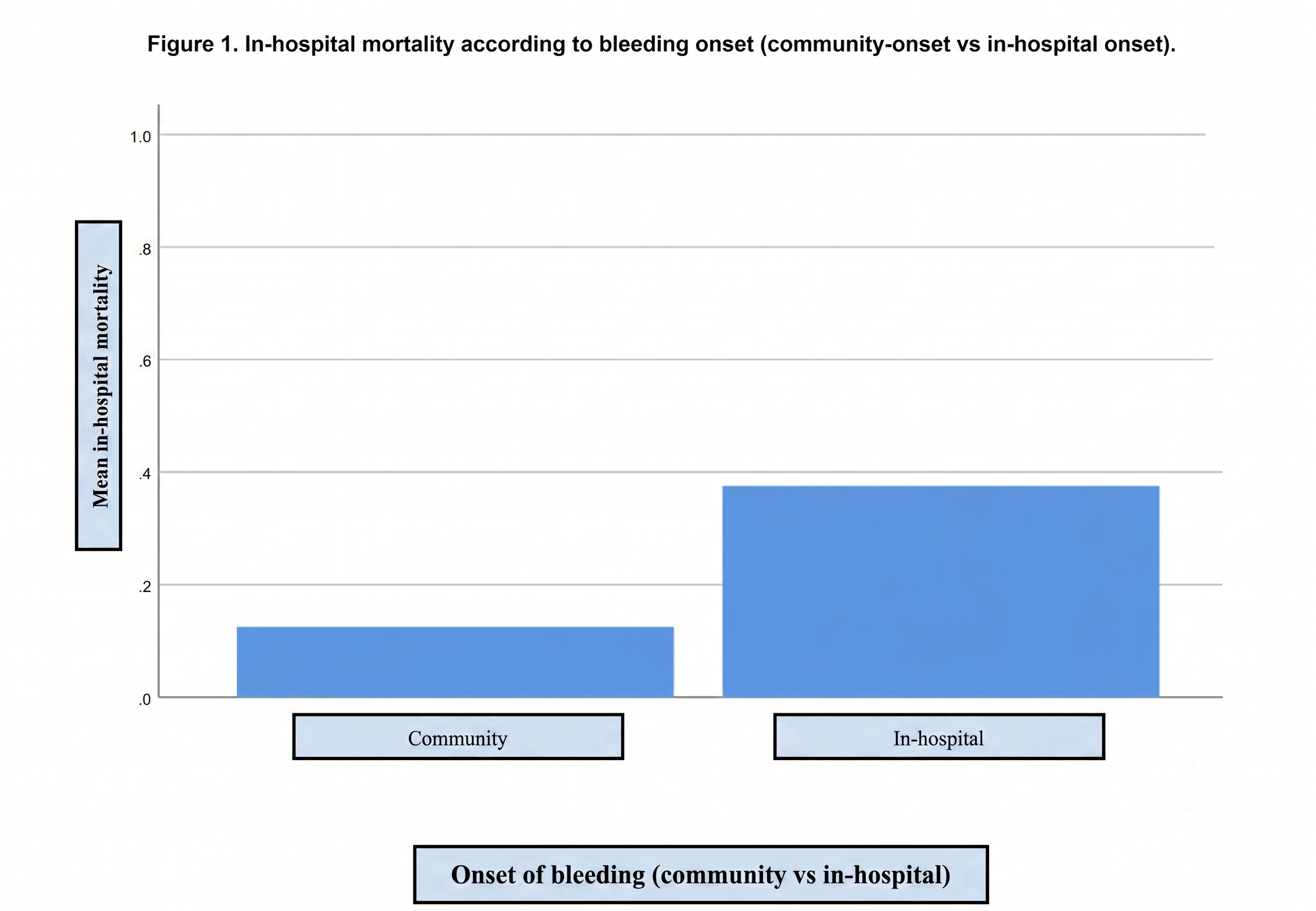 Bars represent the proportion of patients who died during the index hospitalization in each group (N=72).
Discussion
The main findings of this study are that in-hospital onset gastrointestinal bleeding was associated with substantially higher mortality compared with community-onset bleeding, and that serum albumin independently predicted in-hospital mortality in critically ill patients.
In this cohort of 72 critically ill patients with gastrointestinal bleeding managed in intensive and intermediate care units, in-hospital mortality reached 18.1%. This figure is higher than that reported in general gastrointestinal bleeding series, where mortality usually ranges between 5% and 10%, and is closer to that observed in high-risk settings. For example, in a prospective cohort from Ghana, six-week mortality among patients with non-variceal upper gastrointestinal bleeding was 17.4%, whereas in-hospital mortality was lower (7%), likely because patients with cirrhosis, malignancy, and end-stage renal disease were excluded and most patients did not require critical care. Taken together, these data support that the population included in our study represents a particularly severe subgroup, characterized by a high burden of comorbidities and frequent need for advanced organ support (7).
A relevant finding of our study is the difference in outcomes according to bleeding onset. Nearly four out of five bleeding episodes occurred in the community, while approximately one fifth developed in patients already hospitalized for other conditions. Although no marked differences in age, sex, or the distribution of most comorbidities were observed between groups, in-hospital mortality was substantially higher among patients with in-hospital onset bleeding, with mortality exceeding fourfold compared with community-onset bleeding.
This pattern is consistent with previous series of hospital-acquired gastrointestinal bleeding, both upper and lower, in which patients are typically older, have multiple comorbidities, and are frequently exposed to antithrombotic therapies, with reported mortality rates approaching 20–25%. In addition, systematic reviews addressing the “off-hours effect” have shown increased mortality among patients with gastrointestinal bleeding admitted during nights or weekends, partly attributed to delays in early endoscopy and differences in resource availability (10). Our findings suggest that in-hospital onset bleeding may share similar underlying mechanisms, occurring in more complex and fragile patients in whom gastrointestinal bleeding acts as a major decompensating event.
Another central finding of this study is the role of serum albumin as an independent predictor of in-hospital mortality. Patients who died had significantly lower albumin levels at admission, and in the adjusted model, each 1 g/dL increase in serum albumin was associated with an approximate 80% reduction in the odds of death. These results are consistent with those reported by Rodríguez-González et al., who showed that albumin levels below 3.2 g/dL in non-variceal upper gastrointestinal bleeding were associated with nearly a tenfold increase in in-hospital mortality, as well as higher rebleeding rates and prolonged hospital stay. Similarly, in the Ghanaian cohort, low albumin levels were identified as an independent predictor of six-week mortality, together with Rockall score and markers of liver dysfunction. Studies conducted in emergency department settings have also demonstrated that the urea-to-albumin ratio improves mortality prediction compared with isolated variables, reinforcing the role of albumin as a global marker of physiological reserve. (7,11)
In our cohort, Glasgow-Blatchford and Rockall scores were higher among patients who died; however, these variables were not included in the multivariable model due to the limited number of outcome events. This behavior is consistent with previous studies in which Rockall score has been associated with mortality and rebleeding and recommended as a tool for identifying high-risk patients (9,11). Nevertheless, in the critical care setting, factors such as organ dysfunction, need for vasopressors or mechanical ventilation, and the presence of advanced malignancy or chronic kidney disease may modulate the performance of these scores. Our finding that the combination of in-hospital bleeding onset and hypoalbuminemia captures a substantial proportion of mortality risk suggests that integrating markers of patient vulnerability or frailty may improve prognostic models in this context.
Although variables such as chronic kidney disease, history of malignancy, rebleeding, and the need for vasopressors or mechanical ventilation were associated with mortality in bivariate analyses, their inclusion in more complex multivariable models was limited by the small number of deaths. Larger studies have consistently identified advanced malignancy, decompensated cirrhosis, and multiple organ failure as major determinants of mortality in gastrointestinal bleeding, suggesting that our results may underestimate the relative contribution of these factors (8,11).
Limitations
Several limitations should be acknowledged. First, the retrospective design and relatively small sample size, with only 13 deaths, limited statistical power and the complexity of multivariable modeling; therefore, a parsimonious model with two main predictors was chosen. Second, as a single-center study conducted in a referral hospital, the generalizability of the findings to other settings should be approached with caution. Third, some potentially relevant variables, such as detailed anticoagulant use, timing of endoscopy, and standardized intensive care severity scores, could not be included or had incomplete data. Finally, classification of bleeding onset was based on the timing of symptom appearance and may not fully capture the complexity of prior healthcare trajectories.
Despite these limitations, this study provides original data on gastrointestinal bleeding in critically ill patients within a Latin American social security healthcare system, highlighting the worse prognosis associated with in-hospital onset bleeding and the prognostic value of serum albumin.
Conclusions
In this cohort of critically ill patients with gastrointestinal bleeding, in-hospital mortality was high despite specialized management in intensive and intermediate care units. Bleeding of in-hospital onset was associated with significantly higher mortality compared with community-onset bleeding, identifying a particularly vulnerable subgroup of patients. Serum albumin level at admission emerged as an independent predictor of in-hospital mortality and may represent a simple and readily available tool for risk stratification in this population.
These findings support the need for preventive and surveillance strategies in hospitalized patients at high risk of bleeding, particularly those with malignancy, chronic kidney disease, or marked hypoalbuminemia, as well as optimization of nutritional status and correction of modifiable risk factors. Prospective, multicenter studies with larger sample sizes and standardized data collection are needed to confirm these results and to evaluate targeted interventions aimed at improving outcomes in critically ill patients with gastrointestinal bleeding.
Data are presented as n (%) for categorical variables and as mean ± standard deviation for
Binary logistic regression model with in-hospital mortality as the dependent variable. OR, odds ratio; CI, confidence interval. For bleeding onset, the reference category is in-hospital onset.
Bars represent the proportion of patients who died during the index hospitalization in each group (N=72).
Table 3. Factors independently associated with in-hospital mortality in patients with gastrointestinal bleeding (binary logistic regression model).
VariableCategory/UnitAdjusted OR95 CI%pAlbumin (g/dl)For every increase in 1 g/dL0.180.04 – 0.790.023Origin of the bleedingCommunity vs in-hospital0.240.06 – 0.950.042 Binary logistic regression model with in-hospital mortality as the dependent variable. OR, odds ratio; CI, confidence interval. For bleeding onset, the reference category is in-hospital onset. Bars represent the proportion of patients who died during the index hospitalization in each group (N=72).
Acknowledgements
The authors thank the Instituto Guatemalteco de Seguridad Social for granting access to clinical records and for institutional support that made this study possible. We also acknowledge the medical and nursing staff of the Intensive and Intermediate Care Units for their contribution to patient care. This study did not receive external funding.
Funding
No funding was received for the research, authorship, and/or publication of this article.
Author contributions
Kevin Vásquez Dávila : Conceptualización, Redacción - borrador inicial, Recopilación de datos, Investigación, Análisis formal, Administración del proyecto, Supervisión, Visualización, Redacción - revisión y edición, Software, Metodología
Anapaula Aparicio: Redacción - borrador inicial, Recopilación de datos, Validación, Conceptualización
Kevin Molina: Conceptualización, Redacción - revisión y edición, Validación, Supervisión, Investigación
Conflict of interest
The authors declare no conflict of interest.
Ethics statements
Explicit informed consent for publication was obtained [from the participants / from their legal representatives], in accordance with the Declaration of Helsinki.
AI statement
Artificial intelligence tools were used to assist with linguistic revision and/or translation. The authors verified the accuracy, terminological consistency, and scientific integrity of the final text.
Referencias
- Laine L, Barkun AN, Saltzman JR, Martel M, Leontiadis GI. ACG Clinical Guideline: Upper Gastrointestinal and Ulcer Bleeding. American Journal of Gastroenterology. 2021;116(5):899-917.
- Available at: https://doi.org/10.14309/ajg.0000000000001245.
- Gralnek IM, Stanley AJ, Morris AJ. Endoscopic diagnosis and management of nonvariceal upper gastrointestinal hemorrhage (NVUGIH): ESGE guideline—update 2021. Endoscopy. 2021;53:300-332.
- Triantafyllou K, Gkolfakis P, Gralnek I. Diagnosis and management of acute lower gastrointestinal bleeding: European Society of Gastrointestinal Endoscopy (ESGE) guideline. Endoscopy. 2021;53:850-868.
- Sengupta N, Feuerstein JD, Patwardhan VR. Management of patients with acute lower gastrointestinal bleeding: an updated ACG guideline. American Journal of Gastroenterology. 2023;118:208-231.
- De Franchis R, Bosch J, Garcia-Tsao G. Baveno VII—renewing consensus in portal hypertension. Journal of Hepatology. 2022;76:959-974.
- Someko H, Shimura H, Tsujimoto Y, Okazaki Y, Shiojiri T. Clinical Characteristics and Outcomes of Hospital-Acquired Lower Gastrointestinal Bleeding: A Single Centre Retrospective Cohort Study. Cureus. 2022.
- Available at: https://doi.org/10.7759/cureus.32651.
- Essani ZMS, Naeem F, Parkash O. Risk factors and outcomes of upper gastrointestinal bleeding in hospitalized patients in a tertiary care hospital. Journal of the Pakistan Medical Association. 2024;74(2):224-228.
- Available at: https://doi.org/10.47391/jpma.7141.
- Bae SJ, Kim K, Yun SJ. Predictive performance of blood urea nitrogen to serum albumin ratio in elderly patients with gastrointestinal bleeding. Am J Emerg Med. 2021;41:152-157.
- González-González JA, Vázquez-Elizondo G, Monreal-Robles R, García-Compean D, Borjas-Almaguer OD, Hernández-Velázquez B, et al.. Hypoalbuminemia in the outcome of patients with non-variceal upper gastrointestinal bleeding. Revista de Gastroenterología de México (English Edition). 2016;81(4):183-189.
- Available at: https://doi.org/10.1016/j.rgmxen.2016.08.003.
- Xia X, Chiu P, Tsoi K, Chan F, Lau J. The effect of off-hours hospital admission on mortality and clinical outcomes for patients with upper gastrointestinal hemorrhage: a systematic review and meta-analysis of 20 cohorts. United European Gastroenterology Journal. 2018;6:367-381.
- Adu-Darko N, Gyabaah S, Asamoah O. Etiology and short-term outcomes of upper gastrointestinal bleeding in patients presenting at the emergency department in a tertiary hospital in a low resource setting: a prospective cohort study. JGH Open. 2025;9:e70167.
if(window.self!==window.top){ var _st=document.createElement("style");_st.textContent="[data-section-id]{cursor:pointer;transition:outline 0.1s}"+"[data-section-id]:hover{outline:2px solid #6366f1;outline-offset:2px;border-radius:3px}"+"[data-section-id] *{pointer-events:auto}"+"[data-ref-id]{cursor:pointer;transition:outline 0.1s}"+"[data-ref-id]:hover{outline:2px solid #6366f1;outline-offset:2px;border-radius:3px}";document.head.appendChild(_st); document.addEventListener("click",function(e){var el=e.target.closest("[data-section-id]");if(el){window.parent.postMessage({type:"ams-sec-click",id:el.getAttribute("data-section-id")},"*");return;}var rl=e.target.closest("[data-ref-id]");if(rl){window.parent.postMessage({type:"ams-ref-click",id:rl.getAttribute("data-ref-id")},"*");}},true); } window.addEventListener("message",function(e){if(!e.data||e.data.type!=="ams-sec-goto")return;var el=document.querySelector('[data-section-id="'+e.data.id+'"]');if(el)el.scrollIntoView({behavior:"smooth",block:"start"});}); if(window.MathJax&&MathJax.startup){MathJax.startup.promise.then(function(){document.querySelectorAll('mjx-container[display="true"]').forEach(function(c){c.style.overflowX="auto";c.style.maxWidth="100%";c.style.display="block";});});}
Explorar
Artículos
Volúmenes
Sobre la revista
Más leídos
Cáncer gástrico – actualización en diagnóstico y tratamiento: revisión bibliográfica
Gastroenterología Latinoamericana
Cáncer colorrectal – diagnóstico y tratamiento: revisión bibliográfica
Gastroenterología Latinoamericana
Colitis eosinofílica: una entidad aparte
Gastroenterología Latinoamericana
Novedades del consenso de Lyon 2.0
Gastroenterología Latinoamericana
Efecto de la infusión de ácido tranexámico en altas dosis por 24 horas en las muertes y eventos tromboembólicos en pacientes con hemorragia digestiva (HALT-IT): un estudio internacional aleatorizado, doble ciego y controlado con placebo
Gastroenterología Latinoamericana